Beyond Forsyth: Discovering the Soul of Savannah Through Its Quieter Squares
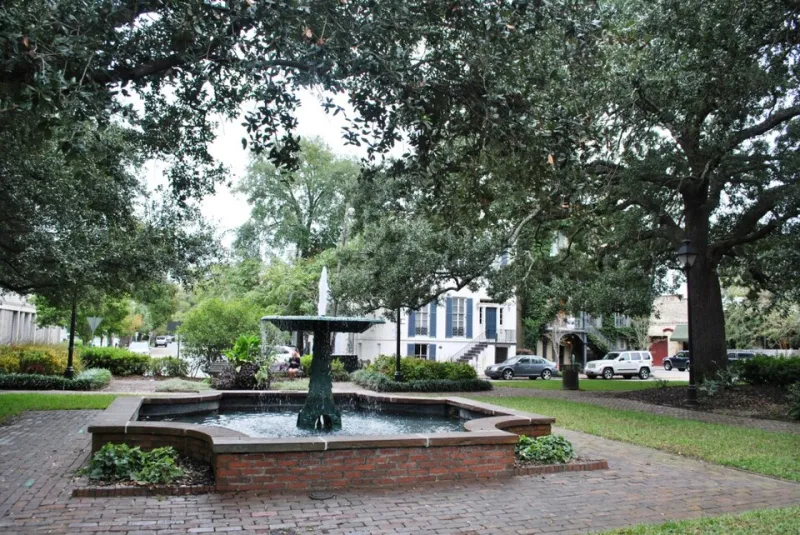
Photo: Elisa.rolle, CC BY-SA 4.0, via Wikimedia Commons
Savannah is frequently celebrated for its lush, fountain-centered Forsyth Park, and rightly so. That iconic green expanse draws visitors from across the country, and its wrought-iron fountain has appeared on more social media feeds than perhaps any other landmark in Georgia. Yet to treat Forsyth as the sum of Savannah's outdoor civic life is to miss something essential about how this city was designed — and how it continues to breathe.
James Oglethorpe's original 1733 city plan introduced a repeating pattern of wards, each anchored by a central square, that would eventually produce 22 distinct green spaces woven into the urban fabric of the Historic District. These squares were never intended as decorative afterthoughts. They served as gathering places, militia training grounds, marketplaces, and memorials. Today, they function as neighborhood living rooms — and the ones that draw the fewest tourists often offer the most authentic encounters with Savannah's layered identity.
Understanding the Square System
Before exploring individual squares, it helps to understand their civic logic. Each ward surrounding a square was originally designed with trust lots (for civic buildings such as churches and schools) and tithing lots (for private residences) radiating outward from the central green. This arrangement encouraged a walkable, community-centered urban form that city planners still study and admire today.
The squares are not identical in size, character, or age. Some date to Oglethorpe's founding era; others were added as the city expanded through the eighteenth and nineteenth centuries. Each bears a name that typically honors a Revolutionary War figure, a colonial administrator, or a significant local benefactor — and each has accumulated its own distinct atmosphere through the buildings, monuments, and daily rhythms that surround it.
Troup Square: A Neighborhood Anchor in the Victorian District
Located at the southern end of Habersham Street, Troup Square is one of Savannah's more understated gems. Named for Governor George Michael Troup, it is distinguished by its armillary sphere — a skeletal celestial globe mounted on a pedestal at the square's center — which lends the space an almost contemplative quality rarely found in busier parts of the city.
The surrounding architecture reflects the Victorian-era expansion that defined this part of Savannah's development, with handsome townhouses and the historic Unitarian Universalist Church of Savannah anchoring the eastern trust lot. On weekday mornings, Troup attracts dog walkers, cyclists, and residents reading on benches — a reminder that Savannah's squares function as genuine neighborhood commons rather than theatrical backdrops.
Visitors who linger here will also notice that the tree canopy at Troup is particularly dense, creating a cool, cathedral-like shade that makes the square an inviting respite during Savannah's famously warm summers.
Calhoun Square: History Layered in Brick and Stone
At the intersection of Abercorn and Wayne Streets, Calhoun Square carries a gravity that distinguishes it from its more ornamental neighbors. Named for Senator John C. Calhoun of South Carolina, the square is framed by some of the most architecturally significant buildings in the district, including the Massie Heritage Center — Georgia's oldest continuing school building, constructed in 1856 — which anchors the square's southern trust lot.
The Massie Center today operates as a living history museum and architectural education resource, offering programming that connects students and visitors to Savannah's built environment. Its presence gives Calhoun Square an educational weight that complements the surrounding residential streetscape of Federal and Italianate-style homes.
For those with an interest in Civil War history, Calhoun Square also sits within a neighborhood that witnessed considerable wartime activity. Walking the perimeter with an awareness of that context — the church steeples, the school, the private homes — transforms a pleasant stroll into a genuine historical immersion.
Whitefield Square: A Gentler Pace at the District's Edge
Near the southern boundary of the landmark Historic District, Whitefield Square offers a noticeably quieter experience than the squares clustered around the main tourist corridors. Named for the evangelist George Whitefield, who founded Bethesda orphanage south of the city in 1740, the square features a graceful gazebo at its center that has become a popular setting for intimate weddings and small community gatherings.
The surrounding neighborhood retains a predominantly residential character, with fewer commercial establishments competing for attention. This makes Whitefield an ideal destination for visitors who want to experience the squares as Savannah residents actually use them — as extensions of front-porch life, places to read, converse, or simply observe the rhythm of a city that has never been in a particular hurry.
Greene Square: Reflecting on Freedom and Community
Located in the eastern portion of the Historic District, Greene Square is named for Revolutionary War General Nathanael Greene and carries particular significance as a space historically associated with Savannah's African American community. The Second African Baptist Church, which faces the square, is one of the oldest African American congregations in the country and played a documented role in the Underground Railroad.
The square itself is modest in scale but resonant in meaning. Standing here with an awareness of the church's history — and of the generations of Savannah residents who gathered in this space through eras of both oppression and resilience — offers a more complete and honest picture of what the Hostess City's heritage actually encompasses.
Planning Your Square-by-Square Exploration
The most rewarding way to experience Savannah's lesser-known squares is on foot, moving through the city's street grid at a deliberate pace. A self-guided walking route that connects Troup, Calhoun, Whitefield, Greene, and several other quieter squares can be completed in a half-day and requires nothing more than comfortable shoes and a willingness to pause.
The City of Savannah's Department of Tourism and Visitor Services offers printed and digital maps of the historic square system, available at the Savannah Visitor Center at 301 Martin Luther King Jr. Boulevard. Staff there can also suggest thematic routes — architectural, botanical, or historical — tailored to individual interests.
What these quieter squares offer, above all else, is proportion. Savannah was designed to be experienced at a human scale, and the squares are the mechanism through which that design intention is most fully realized. Forsyth Park will always deserve its admirers. But the city's truest character lives in the spaces where the tourists are fewer and the trees are just as old.