Between Sidewalk and Sitting Room: How to Enjoy Savannah's Porches Without Overstepping

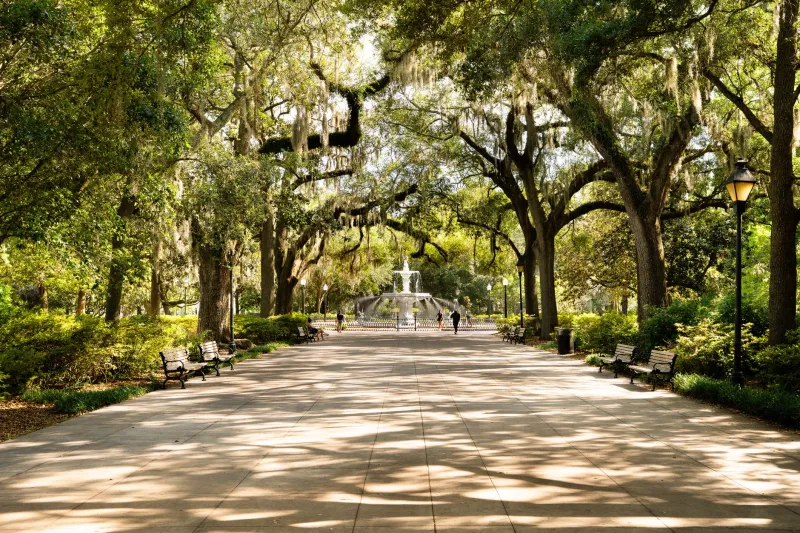
Photo: Gordon Leggett, CC BY 4.0, via Wikimedia Commons
Savannah's porches are one of the city's great civic pleasures, and one of its easiest sources of friction. A traveler sees a shaded stoop, a wrought-iron bench, a courtyard gate left slightly ajar, and the mind leaps to a novel. A resident sees the same stoop and thinks about groceries, a sleeping child, a dog that barks at strangers, and the mail that has not been brought in yet.
This is not a scolding. It is an invitation to enjoy Savannah more intelligently. The porch is the point. It is where the city performs its graciousness, and it is also where people actually live. The line between those two facts is thinner than many visitors realize, and it is worth learning to see.
Why the Porch Matters Here
Savannah's historic architecture is not only about façades. It is about the spaces between the building and the street: piazzas, side porches, stoops, garden walls, and courtyards. These in-between spaces moderate the heat, frame conversation, and allow a household to be both private and present. They are one reason the city feels domestic even at its most touristed.
That domesticity is not a theme-park effect. People sit on these porches. They eat on them, read on them, argue on them, and watch the street from them. When a visitor treats a residential porch as a photo set or a rain shelter, the result is not a charming exchange. It is an intrusion.
The Sidewalk Is Your Balcony
The public sidewalk is where your rights as a visitor are clearest. Stand there. Walk there. Pause there. Admire the ironwork, the shutters, the garden gate, the way the late light hits the brick. Porch-watching from the sidewalk is a legitimate Savannah pleasure, and it is one of the reasons the city rewards walking.
What the sidewalk does not give you is permission to climb, sit, lean, or linger on private steps. A stoop is not a bench. A porch is not a café. A gate is not an invitation. If you need to rest, find a public bench, a square, a café, or your hotel lobby. If you need shelter from rain, use a commercial doorway with the owner's forbearance, not someone's front steps.
Photography With Manners
Photographing architecture is fine. Photographing people is not a default right. If a resident is on the porch, ask before including them in a frame. A simple request, offered with a smile, usually gets a friendly answer. If the answer is no, accept it and move on. Do not photograph through windows, open gates, or doorways. Do not use a long lens to capture domestic life from the street.
If you are photographing a façade and someone is gardening or reading on the porch, a nod and a brief greeting are better than silent hovering. Keep the camera low, keep the visit short, and do not turn a neighbor's afternoon into a photo shoot.
Lingering, Watching, and the Art of Not Commenting
Porch-watching is not the same as staring. A glance, a pause, an appreciation of the scene: these are fine. A running commentary on the porch's occupants is not. Do not narrate someone's dinner, argue about the house's paint color within earshot, or speculate loudly about who lives there. Savannah is a small city, and sound carries.
If you are invited onto a porch, enjoy the invitation briefly. Do not treat it as a transfer of property. Do not rearrange furniture, put your feet on the rail, or stay after the conversation has naturally ended. The host's generosity is the point, not your access.
Gates, Courtyards, and the Private Edge
A low garden wall is not a suggestion. A gate is not a decorative arch. A courtyard that looks empty may be empty because the household is at work, not because it is open to visitors. If a space has no sign welcoming the public, assume it is private. This is especially important in residential blocks, where a single misstep can feel much larger to the people who live there.
If you want to experience Savannah's courtyard and porch culture legitimately, choose a house museum, a historic inn, or a café with a garden. Many of the city's inns offer porches and courtyards precisely so guests can enjoy the in-between spaces without trespassing on a neighbor's evening. House museums show how these spaces were used historically and give you a sanctioned way to look closely.
A Simple Test
Before you sit, climb, photograph, or linger, ask a simple question: Would I be comfortable if a stranger did this on my own front steps? If the answer is no, step back to the sidewalk. If the answer is yes, ask anyway. Savannah's graciousness is real, but it is not infinite. The best visitors return the city's hospitality by recognizing where it ends.
The porch is the point, and the point is not access. It is atmosphere, neighborliness, and a certain way of living with the street. You can enjoy all of that from the public side of the gate. In fact, you will enjoy it more.