Leave the Keys at the Hotel: How Savannah's 1733 Grid Makes Car-Free Travel Effortless
A City Built on Foot
When General James Oglethorpe laid out Savannah in 1733, he could not have imagined the automobile. What he imagined instead was a community in which every resident lived within a short walk of a public square, a church, a market, and a place of work. Nearly three centuries later, that original design remains intact, and it happens to make Savannah one of the most walkable cities in the United States. For visitors, the practical implication is simple: you can arrive, park once, and experience nearly everything the Hostess City offers on foot.
The Numbers Behind the Convenience
Savannah's Historic District covers roughly one square mile. From end to end, it measures about a mile and a half north to south and a little over a mile east to west. A visitor staying near the riverfront can reach Forsyth Park in approximately twenty minutes at a relaxed pace — a distance of just over one mile. Between any two squares, the walk rarely exceeds ten minutes.
Consider a representative full day: morning coffee near Chippewa Square, a stroll through Madison Square, lunch along Broughton Street, an afternoon at the riverfront, and an evening walk through Jones Street. Even combining all of these, a visitor will typically log between three and five miles spread across the day — comfortable territory for most travelers, particularly when broken into short segments.
Designing a Pedestrian Route
Rather than treating the squares as a checklist, think of them as a lattice. The city's grid alternates east-west wards and north-south corridors, which allows visitors to construct loops rather than out-and-back routes. A rewarding pattern:
- Begin at the riverfront for morning light on the Savannah River and the cobblestone Factors Walk.
- Move south through Johnson and Wright Squares toward the shopping corridor of Broughton Street.
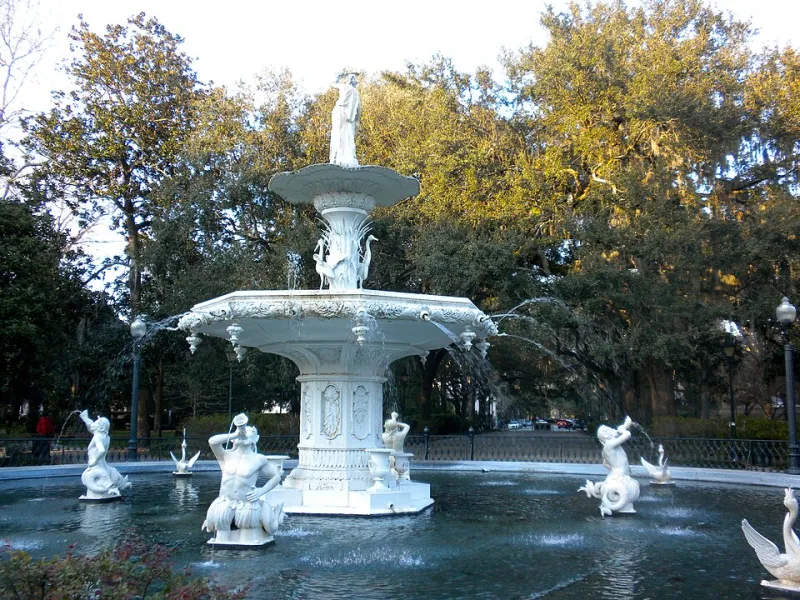
- Continue to Chippewa Square, then follow Bull Street to Forsyth Park and its celebrated fountain.
- Return north via Jones Street, widely considered among the most beautiful residential streets in America.
This loop totals approximately two miles and can be completed in a morning — or stretched luxuriously across an entire day with stops for meals, museums, and shaded benches.
Respecting the Southern Climate
Walking in Savannah requires honest planning between May and September, when afternoon temperatures routinely exceed ninety degrees with heavy humidity. Three strategies make the difference between a pleasant stroll and a sweltering ordeal.
First, schedule outdoor exploration before eleven in the morning and after four in the afternoon. Midday hours are best reserved for air-conditioned museums, long lunches, or rest at your lodging.
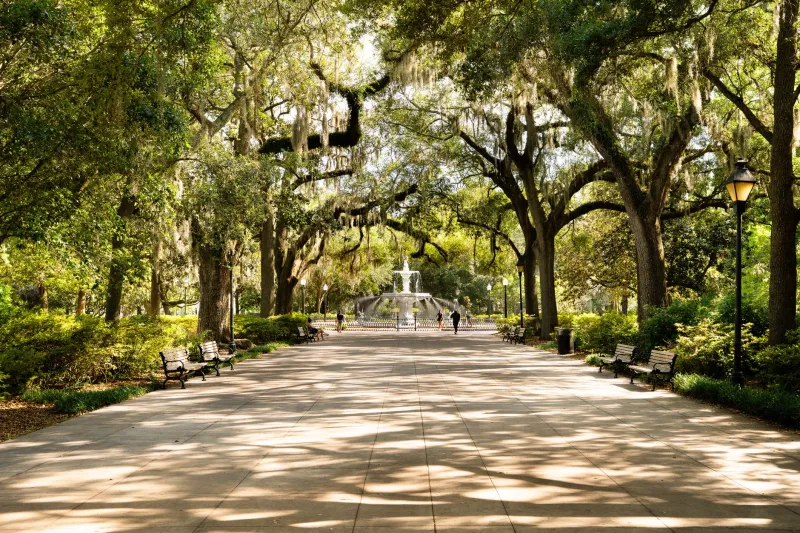
Second, use the squares as they were intended: as shaded refuges. The live oaks draped in Spanish moss form a natural canopy that can lower the perceived temperature considerably. Plan routes to pass through green space every ten to fifteen minutes rather than along exposed corridors.
Third, hydrate deliberately. Public fountains exist in the larger squares, and nearly every business along Broughton and Bull Streets welcomes foot traffic in search of cold drinks. A rest stop every half hour is not indulgence; it is sound practice.
Practical Logistics
Visitors arriving by car should take advantage of the city's public parking garages, several of which sit at the edges of the Historic District near the visitor center on Martin Luther King Jr. Boulevard. Daily rates are reasonable, and garages allow travelers to leave vehicles for the duration of a stay. The Savannah Belles Ferry provides free passage between the riverfront and Hutchinson Island, and the DOT shuttle offers a free loop for moments when feet require a reprieve. Both supplement — rather than replace — walking.
Those arriving by air can reach the Historic District from Savannah/Hilton Head International in roughly twenty minutes by shuttle or rideshare, after which a car becomes largely unnecessary for the remainder of a downtown stay.
The Reward of Slowness
Savannah does not reward haste. Its pleasures — the play of light through moss, the ironwork of a staircase, the quiet of a square at dusk — reveal themselves only to those moving at walking speed. Oglethorpe's grid was a social experiment; walking it is the way to understand what he intended. Park the car, lace comfortable shoes, and let the city unfold one square at a time.